Create a knowledge base for application support
Unleash the power of a knowledge base for application support that is efficient, scalable, centrally available, and clearly structured.

Unleash the power of a knowledge base for application support that is efficient, scalable, centrally available, and clearly structured.
Knowledge is the foundation of IT application support, especially for business applications. First, building up and passing on this specific knowledge takes a lot of effort. Then, this valuable knowledge must be applied and maintained continuously. The place where this knowledge is stored is usually called a knowledge base (KB).
Unfortunately, in practice, the KB is often not centrally located; rather, the content is scattered across multiple documentation systems. Additionally, the content is available in various formats and structures, such as bullet-point notes in files and wikis. Common tools that enable teams to share this content include Microsoft OneNote and SharePoint, as well as Atlassian Confluence and other web-based wiki systems.
Decentralized and unstructured knowledge hinders the development and maintenance of the KB. Without an effective KB, the application support team is subject to several limitations:
To eliminate these limitations, it is crucial to centrally create and clearly structure the KB.
Create a centralized, clearly structured knowledge base.
A support team’s KB should be created in a single online documentation system available to all team members. This allows each team’s specific needs and preferences to be taken into account. This means that not all support teams have to use the same KB. The important thing is that each team searches for and creates content in one place.
Next, create a clear structure for the KB content that all team members know and use as a navigation aid. The goal is for everyone to know where to find what type of content and to create new content according to this structure. This navigation aid lowers the threshold for moving beyond one’s own way of thinking about structures and adopting the team’s approach.
i Thus, the knowledge base for application support becomes a valuable part of the support team.
At least two levels need to be structured:
The containers are used for initial preselection and filtering by content type, e.g.,
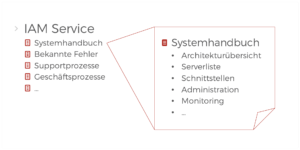
The content in the containers is then structured into chapters according to type. For example, a system manual might be structured as follows:
The following graphic shows this structure for an IAM (Identity & Access Management) service in support.
This structure is a baseline that can be expanded. However, loose collections of content should be avoided. This is where KB moderation comes into play.
In the heat of the moment, it is sometimes necessary to quickly and easily save content. This content is often created in random places within the structure. Then, it is the moderator’s task to work with the author to meaningfully insert this content into the structure or move it to the correct location. This ensures that the content can be found and used by the entire team. This also allows the knowledge base to provide context for application support.
As with any data storage, it is important to avoid redundancies in the KB. If information already exists elsewhere, it should be referenced or linked.
The knowledge base thrives on daily use and supports the quality, efficiency, and scalability of support teams.
Please also read the technical article by our expert in Computerwoche:
Knowledge Base im IT Support – Wie Sie eine Wissensdatenbank aufbauen
RYOSHI has many years of experience in IT application support.
Schedule a free initial consultation today.

 The practical application of Lean ITSM in Application Support